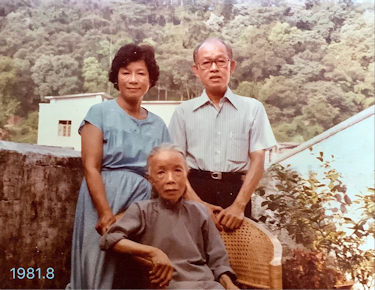
Dad's Biography (1915-2021)This is a short biography of Yun Lai, our beloved dad. It is inspired by the lovely eulogy written by our cousin Yiming on her blog. Some of the earlier year anecdotes are taken from there.
Dad was born into a family of government officials on January 5, 1915 in the city of Wuzhou, Guangxi Province, China. He was the youngest of five siblings. The affluent upbringing did not make him a slacker. Growing up, he had self-discipline and studied hard. He especially liked mathematics and once won the Wuzhou City Mathematics Competition. After graduating from high school, he recognized the needs of the country in its trying times. He decided to forgo his academic pursuits and joined the military. In 1934 he was admitted to the Whampoa Military Academy, the first and only military academy in the Republic of China.
 He became a naval officer after graduating in 1939 and devoted himself to fighting the Japanese who were invading China. During this period, he became the captain of a fleet on the Xi Jiang (Xi River spanning Guangxi and Guangdong provinces in southern China). One time his fleet had to mine the entire Xi Jiang to prevent the Japanese from attacking by water. Because of the war and his military duties, Dad could not return home for several years, and so failed to fulfill his filial piety when his father died. Only later when he was laying mines along the Xi Jiang he had an opportunity to pass through Wuzhou and to pay homage to his father at his grave. When his gunboat entered Wuzhou Port, officers and sailors, knowing that he was going back to his hometown to pay homage to his father, fired three cannons without authorization to honor his father. He was surprised but pleased, exclaiming “It is so loud that my father must have heard in the hills” where his grave was. After World War II ended, the mines had to be removed. Dad told cousin Yiming that it was easy to lay mines but difficult and dangerous to remove them. In the mine removal operations, he was not afraid of hardship and danger. He led by example and went into the water to work with the other officers and sailors. Mom and Dad were married during the war. She attended the Guangzhou Women’s Normal School. Like many youths at the time, Mom was passionate about fighting the Japanese invasion to save China. Mom and Dad met when she, representing the Anti-Japanese Literature and Art Propaganda Team of her school, went to the Whampoa Military Academy to perform and advocate for their cause. After graduation, she worked in Guilin's Salvation Daily newspaper in Guilin.
 Fighting was very intense in the later part of the Anti-Japanese War. Dad could not go home for a long time. He could not go home to take care of Mom during her knee arthritis operation. Due to the war and lack of medical treatment, Mom’s left knee joint was infected after surgery, leaving her with a knee that could not bend. Dad felt very guilty about this. But Mom was very strong and did not let that disability to affect her throughout her life. After Japan was defeated, the civil war between the Nationalists and Communists began. Eventually the Nationalists lost and retreated to Taiwan. Many of Dad’s colleagues followed the Nationalist government there. But Dad was disillusioned with the Nationalists and decided to stay behind in China, thinking that there was not much difference between the Nationalists and Communists. Because he was on the “wrong side“ of the civil war, he had to change his name (from Lai Chungyuen to Lai Yun) to hide his past. To protect himself and his family, documents were burnt, including our birth certificates. As a result, we three siblings do not have official birth certificates. Dad worked in the merchant marine, plying the Pearl and Xi Jiang Rivers between Hong Kong and Wuzhou. The situation was fine for a while until the Communists consolidated power in the provinces. Questions and rumors started to come up about Dad’s past. At some point, Dad figured the situation was getting too dangerous. If the Communists found out about his past, he would have been put in “education camps” for a long time, or could even lose his life. His family would be in trouble too. So one day he “jumped ship” while his merchant ship was docked in Hong Kong. He left the ship and did not return. Relatives in Hong Kong were able to help him. Eventually Mom and the three young children were allowed to leave China to join Dad in Hong Kong; the Communist government did not see the value of having four additional mouths to feed.


As a result of the Japanese invasion and the civil war, our family fell out of the solid middle class. The early years in Hong Kong were challenging as Mom and Dad had to start from scratch after losing everything. But Mom and Dad’s work ethic pulled the family through. They worked as teachers for many years. Eventually Dad became the principal of Deng Zhaochun Primary School. Dad became a devout Christian and was ordained as an elder in the Cumberland Presbyterian Church in 1974.


Dad and mom were excellent parents. Despite of the setbacks in their life, they provided us with a home filled with love. With their nurturing and guidance three of us were able to grow unrestrictedly into adulthood. As children, we understood (probably told by our parents) that we must have a good education in order to make it in Hong Kong. Thanks to the British meritocracy education policy in Hong Kong, getting into good schools was possible for kids from less affluent families. We acquired the work ethic instilled by our parents in our studies. But it was very stressful for young children. David remembers that he broke down crying once during his studies. Dad took him aside and delivered his “all roads lead to Rome” pep talk. He told him that you should try your best. If it does not produce the results you want, that is fine because there will be other opportunities. He even put up an “all roads lead to Rome” slogan on the wall to encourage us. David remembered this pep talk all his life. One of Dad’s advices that Peter remembers is that you do the best you can but don’t set your expectation too high to avoid disappointment. Peter also remembers that when he was not doing well in mathematics in high school. Dad sat him down and instructed him to work on all the problems in the books on arithmetic, algebra and geometry. Within one year Peter became one of the top students in class. Dad’s older sisters and brothers and their families remained in China. Our family lost contact with them. Our cousins in China knew of a Number-2 uncle. But for many years, due to political reasons, no one in their family dared to mention this Number-2 uncle publicly lest getting into trouble with the government. Opportunity to reconnect only came after the reform and opening up of China in the 80’s. Dad’s older brother finally got in touch with Dad. Later, Mom, Dad and Margaret had the opportunity to visit them in China. Dad maintained contact with them after we settled in the United States. David and his wife Sally also visited these relatives in Wuzhou and Guilin in 1985. Dad helped financially to move his father’s tomb to a new location as economic development started to encroach on the old cemetery.


Eventually Mom and Dad settled in Jersey City, living with their daughter Margaret. For several years, Mom and Dad helped out the finances by working in a clothing factory nearby. Dad learned to drive and got his driver license at 65. He did not stop driving until he was 101.
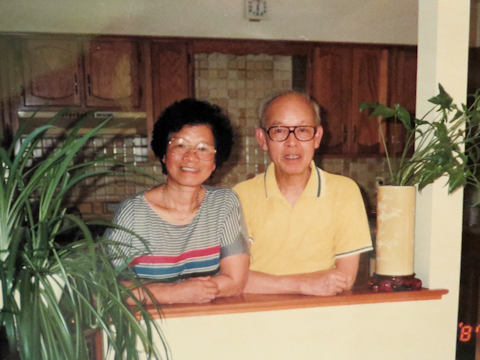
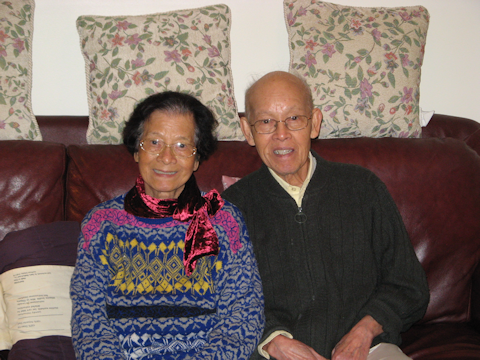
Mom and Dad liked to travel. In addition to visiting China, they also went to Taiwan, Vietnam, Singapore, Philippines, Canada and even Japan. They also did a whirlwind tour of Europe and took a cruise along the coast of New England and Nova Scotia.


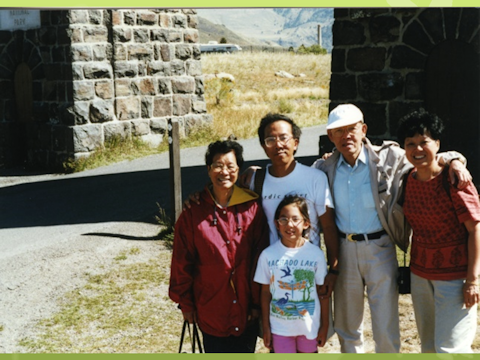
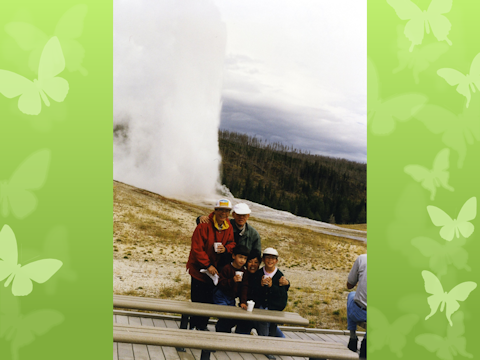
Dad told David once that he wanted to visit Yellowstone National Park, a place he had read about and never had a chance to go. So one summer, David’s family, Mom, Dad and Margaret piled into a rental minivan and drove from Seattle to Yellowstone. We saw all the things Dad had read about - Old Faithful, the bubbling mud holes, sulphur-smelling hot springs and buffalos. He enjoyed the trip very much.
Dad had a meticulous nature. His writing was very neat and beautiful. In his youth, due to the lack of printing technology, mimeographs were frequently used for producing documents in schools and other organizations. Neat handwriting and carefulness were essential in this work. Dad became a master in doing that in the Military Academy. Dad was not very handy. In the New Jersey household, Mom was the “handywoman”. In addition to cooking, she was the one to fix things in the house. Dad’s meticulous nature led him to take care of house cleaning. He had a daily routine. He started the day with personal grooming, followed by some light physical exercise. Then he took care of the cleanliness of the house – dusting and vacuuming. We can see his meticulous traits in some of our family members.
Dad also had a sense of humor. David still remembers the “break wind poem” he recited to us when we were kids. We thought that was hilarious. Once a while, he would crack one-liners, even when he was over 100. Mom and Dad lived with Margaret until their passing. She was the most devoted child to them. She was their caregiver all these years. It is very hard taking care of aging parents. David and Peter are forever grateful for her devotion and caring. Dad never had serious illnesses. He was still very capable, helping Margaret to take care of Mom, when he was 95. He was lucid even at the end at the age of 106. It is a blessing that he passed comfortably and without pain at home with Margaret by his side. While he had lost some memory, Dad did not have dementia. Sally and David had a video call with him a month before his passing. When asked to identify who he was looking at on the phone, he replied “That is David’s wife” without hesitation. To him, “white people do not look alike,” even at his old age! Thanks, Dad.


 < 


Back to Home Page |