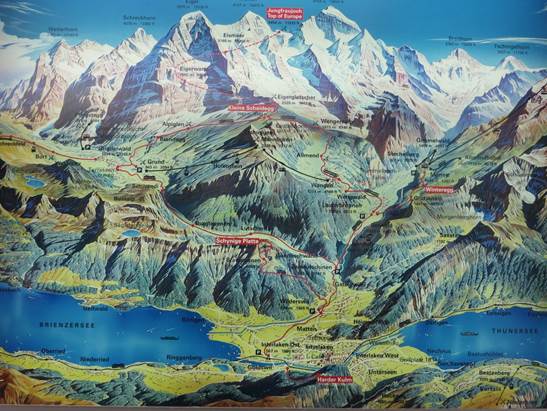
16 August Saturday. From Kleine Scheidegg to Murren. At the train station, John buys a black Jungfraujok T-shirt. Together we walk down toward the village of Wengen, on a path that stays close to the railway. It’s a nice walk – cloudy but not rainy. There’s a train underpass where, in an annual ski race, the skiers must duck their heads to pass through, because the snow here in the winter is so deep and raises them up to the ceiling.
Maps of trails
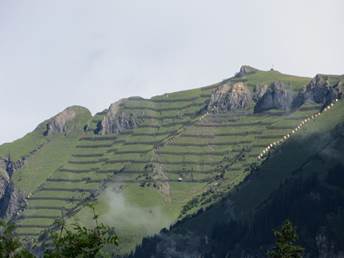
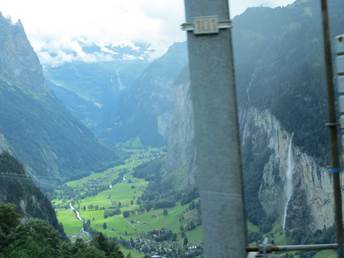
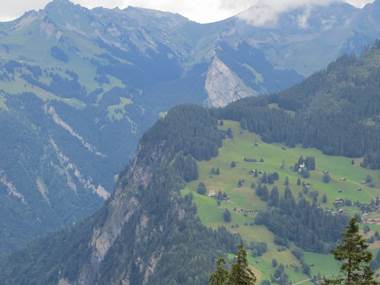
(L) Avalanche barriers on mountainside (R) Lauterbrunnen Valley from cable carAt Wengen we find a café for lunch. Barley soup for me; goulash soup for Lorraine, a cheese pizza on a baguette for John, and a brotwurst for David. The waitress is a tall blonde in her late 40s. From her accent we guess she is Australian, but no, she’s British. We take the train to Lauterbrunnen, then a cable car up across the valley to Grutshalp. We watch a Swiss family (mother and son) play a large outdoor game painted onto the concrete, called “Meuler” (means mill). It seems to have some elements of Tic-Tac-Toe, but more complex.
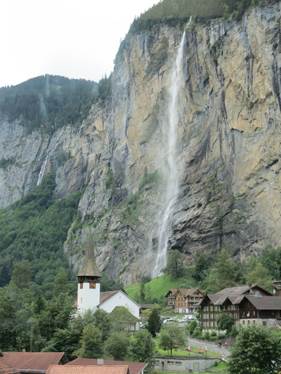
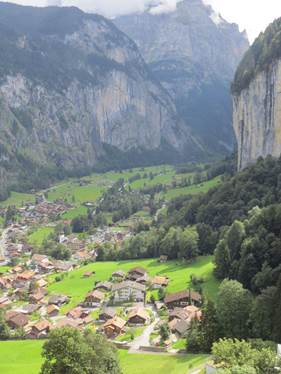
(L) Waterfall from top of Lauterbrunnen Valley (R) A village in Lauterbrunnen Valley
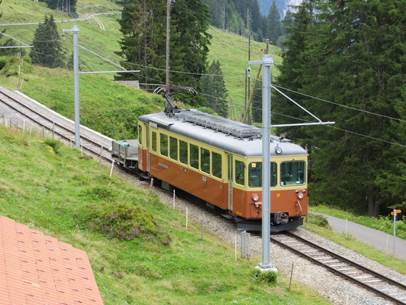
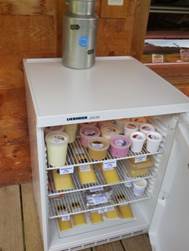
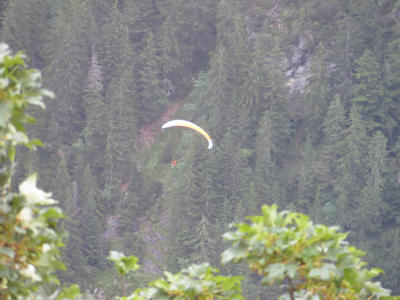
(L) Top of Lauterbrunnen Valley from cable car (R) Train with luggage cart in back/frontWe walk from the cable car station to Murren, stopping on the way at a self-service farm stand with its own cheese. We buy some, but wish there was someone to talk to about the choices. At Murren, our hotel is Alpina. We are very tired when we arrive, plunk ourselves in and take showers and enjoy spectacular views from the dining room where beer and appetizers merge into dinner. Alpin is at the edge of a cliff overlooking the Lauterbrunnen Valley. We enjoyed watching hang gliders going down towards the valley floor. The clouds are starting to lift, giving us partial views of the Jungfrau and Eiger across the river valley. David and the meterologists are predicting that our next two days – Sunday and Monday – will be clear.
(L) Self served cheese at Winteregg, a train station with a few farms (R) Hang glider down to Lauterbrunnen Valley17 August Sunday. Today we will walk to Rotstockhutte for a one-night stay. John and Lorraine talk to hotel staff to try to figure out how challenging this hike will be. Breakfast is a nice yogurt with muesli, bread, cheese, and good coffee, and Ovomaltine in packets.
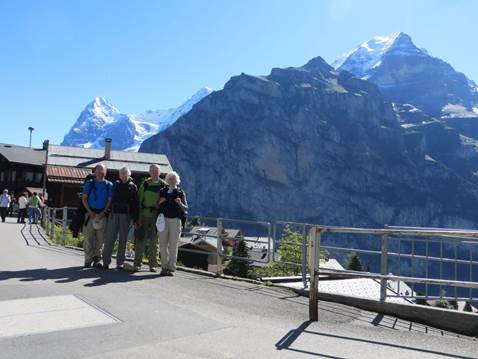
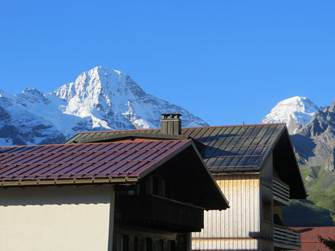
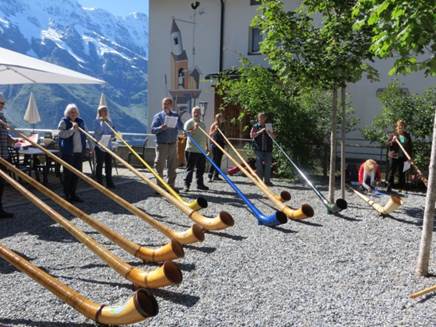
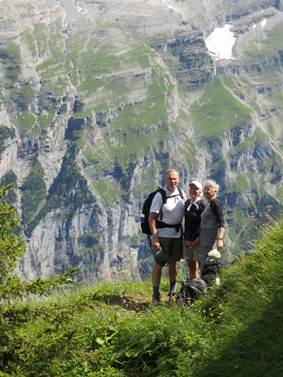
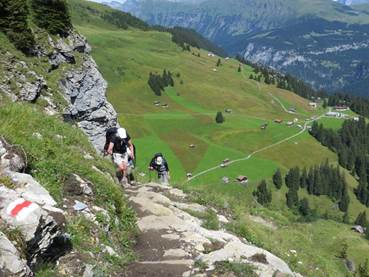
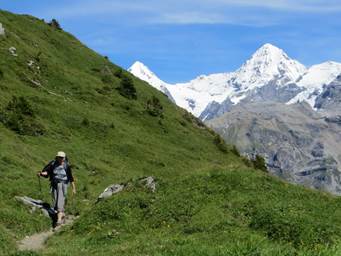
(L) At Murren. Eiger and Jungfrau in the back (R) A perfectly clear dayFrom my hotel room we hear Alpenhorns. I grab Lorraine and we head out to the street where a group of 16 Alpenhornists is warming up for an impromptu concert. Taking a break between performances, their conductor leads them down the street to a water trough, where he demonstrates by putting the mouth of the horn just above the water, that blowing through the horn creates a column of air that vibrates through the horn. (I didn’t understand this experiment.) For the first part of the concert the 16 play together, with some playing harmony. The name of the first piece on the printed music is something in fancy unreadable Germanic script, like “Pister.” The group breaks into two rows of eight facing each other about 50 to 60 feet apart. They play a “call and response.” The sounds are slow, stately, as rounded and deep as the mountains. A member of the group tells me, “These are natural sounds – natural intervals. Some people tell us it touches them deeply.” Another Alpenhornist tells me the conductor is a former professional French horn player from Zurich. Searching the Internet, I learn he is Matthias Kofmehl. At 11:30 am we hike up the road toward Gimmela. After an hour we have left the paved road and are on a track. We crossed the Schiltbach (large creek) at a restaurant/farm with several people eating outside. Again Lorraine asked how difficult the trail was to Rotstockhutte. One person said, “Oh, you can do it, it’s not bad.” But the next section of trail was quite steep with treacherous footing, and we had to go very slowly. Once up the steep part, it became easier. The trail crossed a series of meadows and was mostly level. We could look up high and see the Schilthorn, a prominent peak near the Rotstockhutte. After passing one farm, thinking and hoping it was our hut, we finally could see a more distant hut/farm at the base of a steep hillside, with cows tiny dots on the mountainside behind. Their bells sounded continuously, and herders were bringing them down from higher up, “Woh-oh!” a two note call, first high, then lower. The way crossed several streams and was quite muddy, and we had to watch for cowpies.
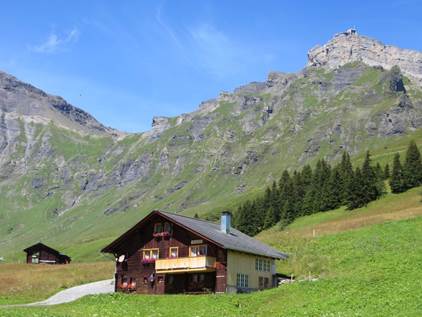
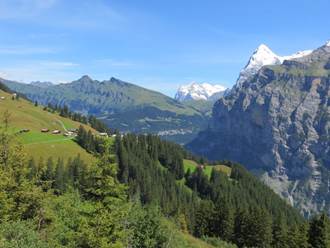
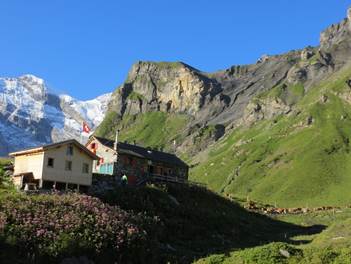
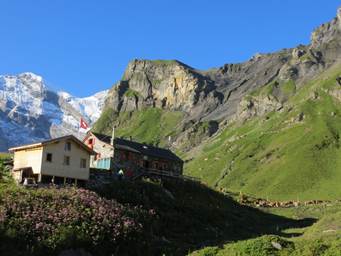
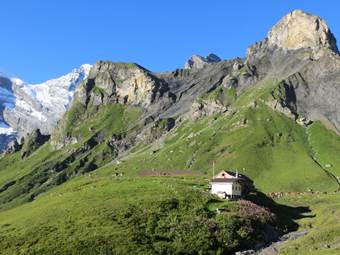
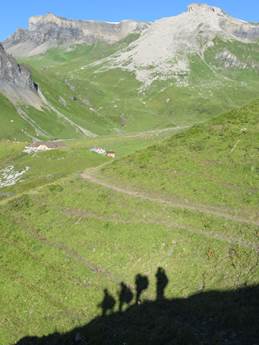
Scenery on trail to Rotstock Hut. Schilthorn with cable station and restaurant (of course) in background
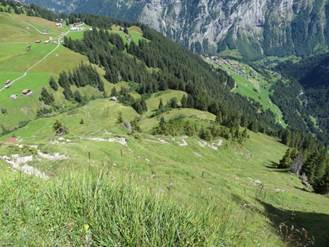
(L) Scene along trail (R) We came up those switchbacks
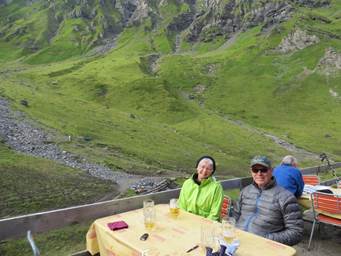
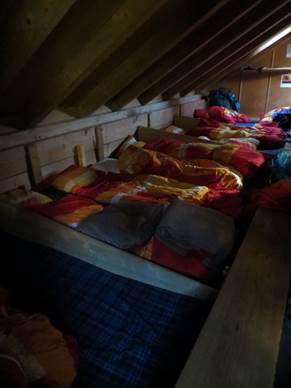
(L) On top of the trail (R) It is a long way upWe reached the hut and checked in, putting boots in the boot room and putting on Crocs. Our bunkbeds upstairs are four in a large bunk room with easily 24 bunks, 12 on a side. There is barely space in the center aisle to prop your backpack against the foot of the bed. We found the separate washroom building with its flush toilets – no showers here – and washed our faces. Unlike the other Swiss huts we went to, there is no hot water. This hut is more like the Kepler Train huts in New Zealand. And then out to the tables on a terrace outside the hut, for beer.
(L) We are almost there - Eiger and Jungfrau in the back (R) Picnic table at Rotstock Hut
(L) Dormitory beds in Rotstock Hut (R) Rotstock HutIn her inimitable way, Lorraine made friends: Fabrizio, a tiny Italian, a professional hiking guide who is here in Switzerland researching where he may take clients. Regarding the Via Ferrata he is dismissive – “they are not safe. I would not take my clients there, it is better to use real climbing equipment and skills and do the climb properly.” We ask his favorite hikes in Italy, and he is non-commital, saying they are not as spectacular as the Swiss Alps, with their snow caps and glaciers. We also met (for a second time – they were also at Grindelwaldblick), Janet and Neal, Australians on a many-day trek. She is an oral surgeon who last year came here and hiked the Haute Route, by herself. Her companion Neal is retired, is a grandfather, and jokes about his slow hiking. Felix is a 50-60-year old school psychologist from Fribourg, Switzerland. He works at a private school where many students have behavioral and other difficulties. He notes that Swiss parents are not as ready to medicate their children as Americans are. “But sometimes, you can’t make progress without using some medication.” A whole family is lined up on the bench opposite our table. Israelis, they come to Switzerland every year to hike and visit huts like this one. The two older men – 60 or 70? are married to the two women who are sisters. The two young people with them are the daughter of one of the women and the daughter’s boyfriend. How long have you been together? We ask them. Six years. “Oh you should get married…this is a lovely place to get married,” we josh them. “What do you do for a living?” Asks Lorraine. “We are all CPAs,” one of the older men says. Is this a joke? We have no idea. Dinner is at 6:30 pm. Bread, mashed potato, green salad, beef stew. Dessert is a small piece of cake with a drizzle of chocolate -- not very sweet, but good. At dinner, we are charmed by Maxim (Maximilian), a 10-year old from Switzerland who is there with his father, a German, and the father’s friend. Max shows off his many languages, speaking to us in English and also Russian, because his mother is Russian but now has a Mexican boyfriend and a new one-year old brother. Of course, Max knows French and German as well. We pee, wash faces, brush teeth and go to bed. It is hard to sleep with a bunkmate just inches away. It is very cold outside (high 40s?) but the bunk area gets so warm from all the bodies, that it is a relief to go out in the middle of the night in the outside cool air to go to the restroom.
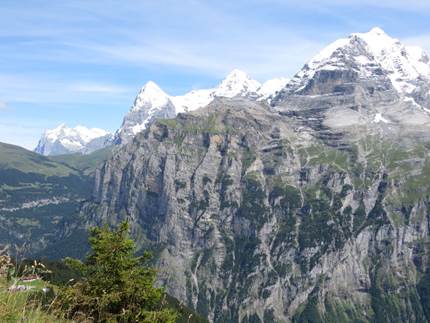
(L) Notice the cattle next to Rotstock Hut (R) Fantastic setting of Rotstock Hut18 August, Monday. Some hikers rose early and have already headed off. We are up at 7, have breakfast, pack up and are out by 8 am. We watch the cows being herded back up into the hills. We cross the muddy streams and head across the meadow. We see a cable line that seems to be carrying a load of cheese rounds away from the farm, to ? another village? To Murren? It is a beautiful, absolutely clear day with full views of the Jungfrau, with the Eiger partially in view. I count the cake layers of Swiss Alps: (1) Deepest down is the dark gorge of the Aare River. We cannot see the bottom, but there are hang gliders sailing across the void. (2) The dark green forested slopes rising out of the gorge. (3) Lighter green meadows, pastures, rolling and creased by streams, with occasional darker trees. (4) The gray of bare rock and rockslides in fan shapes, some areas the black of coal. (5) The white and gray of glaciers and snowcaps, marked in some places with dark bare rock.
(L) Farewell to Rotstock Hut (R) Mountains across Lauterbrunnen ValleyIt is pleasant to retrace our steps to Murren. We eat lunch outdoors at the hotel café where the Alpenhornists performed yesterday. Spectacular views of the Jungfrau and Eiger with hanggliders sailing in the space of the gorge. We take the train back to Grutschalp, then the cable car down the mountain to Wengen, then train to Interlaken, then train to Bern, then train to Geneva. We check back into our Geneva hotel. Familiarity is welcome when we are so tired and the day has been so long. We walk down the street to Duke of Brunswick Park to find the Cottage Café once again. They are busy, of course: will you wait half an hour for a table? Yes. We eat more delicious Mediterranean tapas. I try the lake fish with horseradish. It is delicious, as is our favorite beer, Rugenbraugen. 19 August, Tuesday. Train to airport. John and Lorraine head off to British Airways. David and I watch, bemused, as our two daypacks (with poles attached on the outside of mine) are shrink-wrapped into a single Glad Wrap bundle, for a mere 30 swiss francs. There is an extra line for emigration/security than we had expected, so we just barely make it to the gate. No time to buy chocolate! We flew to Dulles in DC where our flight is delayed by four hours – our plane got stuck in Chicago due to thunderstorms and can’t reach Dulles. Finally, we reach Seattle and get home after midnight. AfterthoughtWhen we started the planning the Switzerland trip, we made a conscientious decision to use the local transportation system and not to drive a car. It is partly due to necessity since we are going from hut-to-hut. The task of figuring out how to go from a big city to a trailhead in a small village is daunting until we find the websites for the Swiss train and postbus. They provide interactively the entire schedule and itinerary of your trip, including the time required to walk to your connection points (such as from a train station to a bus stop). While this is great, it is a bit nerve racking at the beginning since most of the time between connections are 3-10 minutes, including change of stations. But thanks to the Swiss time precision, trains and buses all arrive at the designated times. We experienced only 2 delays out of the many connections we have made. Talking about Swiss time, hiking "distances" in Switzerland are identified by time only, from guide books to trail markers. It is very difficult to find out how far (in our tradition, distance) a hike is unless you have a map. I heard two arguments about this. In our tradition, while distances give you an idea how long it takes you to get there only if you know how fast you can go which depends on the terrain as well as you fitness. When measured in time, one can/need to adjust the time according the how fast you can go, similar to the adjustment you have to make with the given distance. Swiss just like to think in time, not surprising consider their watch making tradtion.Recently we have mixed in some hikes in our foreign travels - China, Korea and Switzerland. We found these hiking time refreshing, a break from eating and sightseeing. It is interesting that in these three countries, the mountains are made very accessible to the general public. I went into a debate with other people about this tradition versus the purists in the US who want to lock up beautiful natural areas as wilderness. As a results these wilderness areas can only be enjoyed by people are able to carry 30-40 lb backpacks. In Switzerland you still have to be physical fit to do the hikes, but you don't have to carry eveything with you. There are three major languages spoken in Switzerland: French, German and Italian. Unlike in Belgium, the Swiss seem to get along well as a federation. We were told it is partly because the cantons operate with a high degree of independence - each has its own constitution, parliament, government and court. Interestingly, while the Swiss we met speak fluent English and their own language, they seem to have trouble speaking the other Swiss language. We met a German speaking Swiss who volunteers in a hut as a server in order to learn to speak French (the hut is in the French region). There was also this 18-year old snowboarder I met on the train. He is from the German speaking region. He told me he has never been to Geneva becasue he does not speak French. But he speaks fluent English. We talked about the poor conditions of the Russian half-pipe in the Sochi Olympics! Previous Page (3) Sign Guestbook Back to Home Page |