China Trip August 2007MiscellaneousWe had problems using foreign travelers checks – could only be exchanged for local money at the Bank of China in big cities. In Gansu, we could not cash our traveler's checks outside Lanzhou. My suggestion is to carry foreign cash – much easier to exchange at local banks, especially in smaller towns. We used ATM several times without a hitch. My strategy was to use ATM only when the banks are open so that I can have somebody to complain to if the ATM takes my card. Fortunately nothing dramatic like that happened. We did not get sick from the food, although we ate a few times in hole-in-wall restaurants. But of course we avoided ice and uncooked food. However I developed two cases of allergy. The first one was due to poison ivy that I contacted in New Jersey before I went to China. But the second one was a rash which definitely was related to something in China; I just don't know what – water, air pollution, laundry detergent, bed sheet. The rash gradually went away after I came back to the US. On the matter of food, we are under-whelmed by Tibetan food. Its claim to fame is a dish called "hand-pulled mutton". It is boiled mutton. You dipped the mutton to a bowl of chili power for taste. What is the big deal about "hand-pulled" (the mutton was torn from the bones by hand)? That is why Tibetan food is not famous around the world. We had Sichuan food several times. To our surprise, the authentic Sichuan food that we ate in Gansu is exactly the same as we have in the US, from Kung Pao chicken to spicy beef noodle soup. We were amazed by the cell phone coverage in China. There was good coverage in most places we went, including a small town Langmusi up in the mountains (11000 ft altitude) between Gansu and Sichuan. We only lost coverage in the vast grassland in the Tibetan region between Langmusi and Xiahe. China has developed quite a network of roads. There are freeways in Shanghai, of course, but also in Gansu. The freeways in Gansu are mostly toll roads. There is also a network of secondary roads in Gansu that connects the villages. They are decently pathed roads. I don't know how far down the network before you reach the dirt roads. But all the roads we were on were decent. There is one thing about the Chinese roads that is not desirable. Roads are often built by cutting into the hillside – nothing new here. But instead of stabilizing the hillside first and build the roads later, the Chinese do the opposite, or sometimes not even bother with stabilizing the hillsides. As a result, there are frequent mudslides. We were stuck behind one once; it was quite an adventure. I guess there is something to pay for moving too fast. 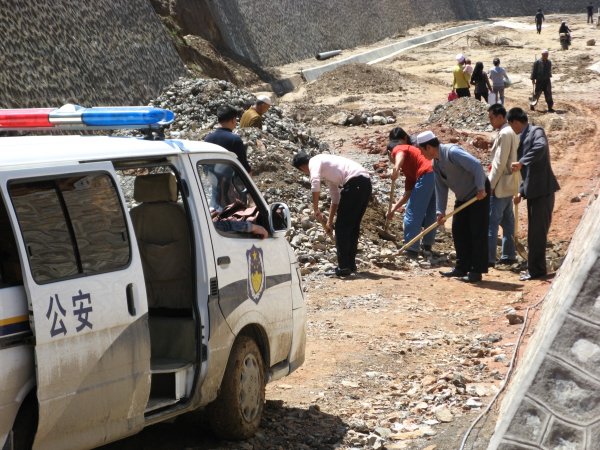
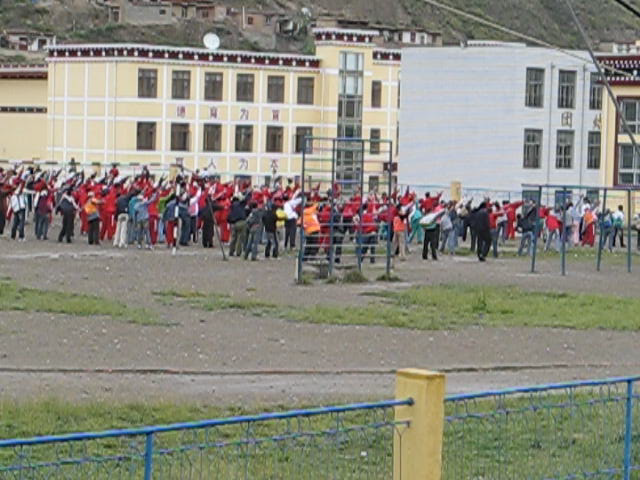
A mudslide which the entire new road New school in Xiahe. Did it survive the 2008 earthquake?We saw a lot of new school buildings (primary and secondary schools) in the small towns and villages that we went through in Gansu. I also know that the 9-years of compulsory education in China is not free. (Only Communist China can come up with such a name for its not-free education). There are sad stories of kids from poor families that cannot afford to go to school. What is wrong with this picture? There is money to pay for new school but no money to provide a free education. What kind of socialism is this? One of the highlights of our trip is meeting a local Chinese in a hole-in-the-wall Muslim restaurant – that is one of the reasons why we do not join tour groups. He is an English teacher from Sichuan traveling through the area. We spent 2 hours chatting away. Topics included education, Falun Gong, corruption in China, housing and inheritance in China and the US. It was extremely interesting and rewarding. Sign Guestbook Back to Home Page Back to China Trip Main Page Lanzhou Binglingsi Grotto Maiji Shan Grotto Langmusi Xiahe and Labrang Monastery Miscellaneous |