
Hiroshima and MiyajimaWe went to Hiroshima for two reasons: to see the the Peace Memorial Park, which contains memorials to victims of the atomic bomb, and to visit Miyajima, a sacred island only 30 minutes from the city by train. The first atomic bomb used in warfare was dropped on the city of Hiroshima on August 6, 1945. The blast killed tens of thousands of people instantly, and in the following years the death toll rose to almost 200,000. In the 1960s, the city of Hiroshima established Peace Memorial Park on an island near the hypocenter (the point at which the atomic bomb exploded). The park contains a number of memorials, including the Children's Peace Memorial and the recently relocated Korean A-Bomb Memorial, all to remind the world of the horror of atomic weapons. We visited the Peace Memorial Museum, which houses exhibits about the history of the war and the United States' decision to use the atomic bomb, the physics of the bomb itself, and the victims' personal stories. Just across the river from Peace Memorial Park is the A-Bomb Dome, which was originally the Hiroshima Prefectural Industrial Promotion Hall. It was one of the few buildings left standing after the blast, although it was within a hundred meters of the hypocenter. Everyone inside the building died instantly, but the structure survived because at the hypocenter the force of the explosion was mostly vertical. The A-Bomb Dome is the only surviving building that was preserved during the reconstruction of the city; it is now a UNESCO World Heritage Site. Viewing the exhibits and seeing the memorials in the park was a sobering experience. Our thoughts on the war and Hiroshima's memorials will be included in the miscellaneous section of the website after the trip. 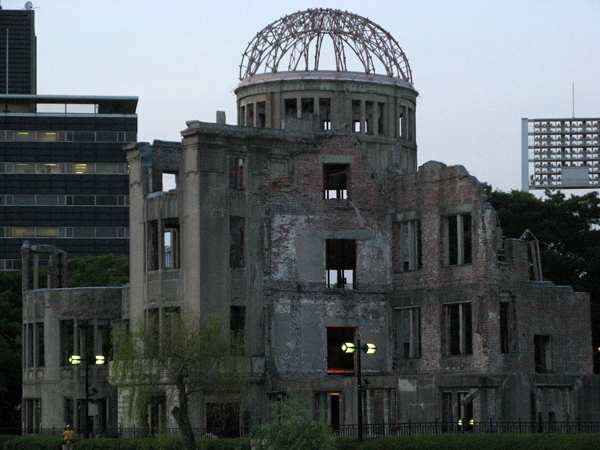 The A-Bomb Dome at dusk. Statue of girl and paper crane, part of the Children's Peace Memorial.Miyajima is a sacred island with many temples and shrines, both Buddhist and Shinto. It is also home to the famous "floating torii," one of Japan's three most scenic views. At high tide, the water covers the foot of the torii so that it appears to float. At low tide, people can walk out to the torii (there is a large tidal range in this part of Japan - we estimated that it was is more than 10 feet). 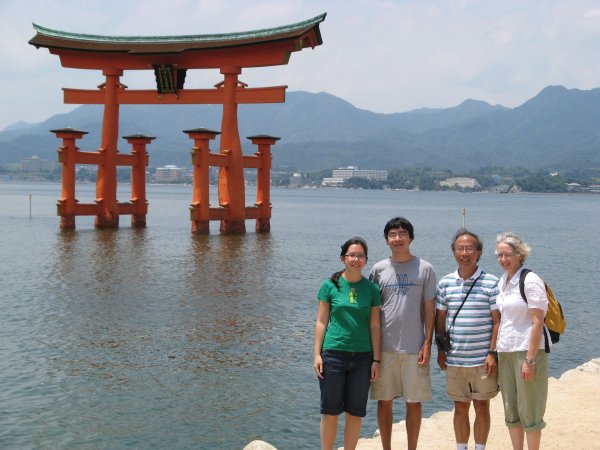 Torii floating at high tide.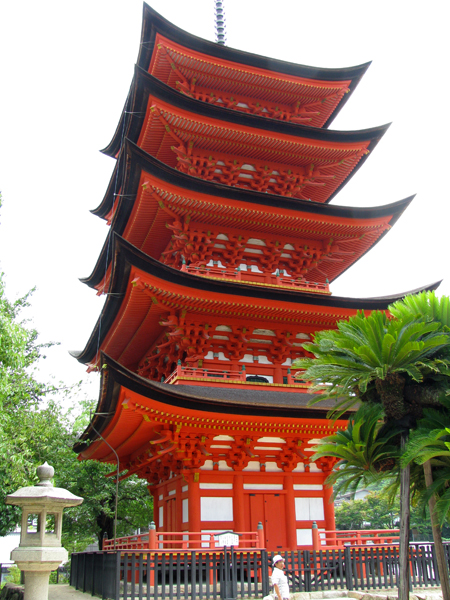 Five-story pagoda on Miyajima.Miyajima is easily accessible from Hiroshima: half an hour by train plus another ten minutes on a JR ferry. The island's highest point is Mt. Misen, reachable by either cable car or hiking trail (due to the heat, we opted to take the cable car both ways). From the top, we could see the Hiroshima metropolitan area and the islands in the Inland Sea. We toured the Mazda Museum at the company's headquarters in Hiroshima. The highlight of the visit was the assembly line. We had expected the assembly line to be completely automated, but instead, actual human beings constructed the cars (with the help of power tools and a few robots). Unfortunately, we were not allowed to take pictures inside the plant. Sign Guestbook Back to Home Page Back to Japan Trip Main Page Tokyo Part 1 Kyoto Himeji Castle Fushimi Shrine Takayama Kiso Valley Tokyo Part 2 Food Japan and the War (Under construction) Miscellaneous (Under construction) |