|
Seoul - Part 1Sally flew from Seattle to Seoul via San Francisco and Osaka. She lucked out on the San Francisco to Osaka leg. The B747 was only a quarter full. She had room to stretch out in her row of 3 empty seats. In the Osaka Airport, she almost missed her flight to Seoul for being too absorbed in talking to some people she just met without noticing the gate for her flight has changed. Luckily she caught it before it was too late. We met up at the Incheon International Airport easily - our planes arrived there within half an hour of each other. Incheon is located on an island 30 miles away from Seoul. The airport is new and spacious. We took the express train into Seoul. When we got off, we were famished and went into the nearest restaurant that we found in the train station. The meal was awful. Sally had a bowl of “beef broth noodle” which was like beef broth with no seasonings at all. David had a “Hangover Soup” which turned out to have cubes of beef blood in it. What happened to the spicy Korean food that we like in the States? Turned out that if we had looked harder, we would have found a nice food court in the train station that served all kind of tasty Korean food. Off to a bad start. Sigh.
Fancy and Spacious Seoul AirportAfter the awful dinner, we took the Metro to Hotel Pop Jongno, a Korean hotel centrally located near some parks and temple. Seoul Metro is huge with many lines. We have a good Metro map (thanks to Android apps) and quickly learnt how to navigate the system. There are also good maps in the Metro stations too. What amazed us were the 3D Metro maps shown in each station. They show the various levels of the different Metro lines, with stairs, escalators and exits. Frequently there are many exits in a station, and choosing the right one can save you lots of walking. It must take an educated population to make these maps useful. We also ran into some storage bins of gas masks in the middle of a station platform. It is a reminder that South Korea is still in a state of war wariness.
(L) 3D Seoul subway map (R) Gas masks stored in subway stationWe spent the next day visiting the downtown area and Namsan (a mountain on the south side of Seoul). As we walked to the Metro station, we lucked into seeing the Korean “changing of the guards”.
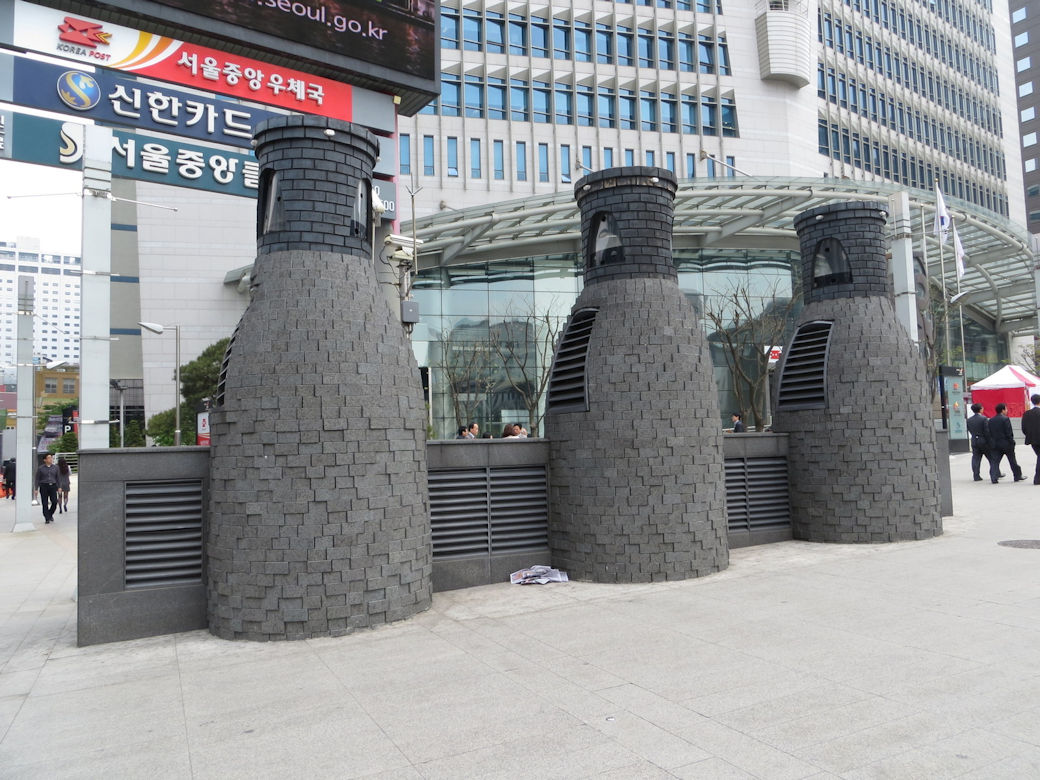
We took the Metro to City Hall. It is a modern building with a glass façade shaped into the curve of a breaking wave overshadowing old city hall which is now a city library. Among the high office buildings we saw some strange looking fixtures. It turned out that they are ventilation vents modeled after traditional Korean chimneys. We even saw a hammer man sculpture, very similar to the one we have in Seattle.
(L) Seoul City in the shape of a tsunamic (R) Ventilation vents for modern buildings in the shape of traditional Korean chimneysWe walked south to Namsan, using surface streets and the underground network of shopping centers. (It is very cold here in the winter and so those underground shopping centers are very useful. This reminds me of Montreal). We took the cable car to top from which we have a good, but hazy, view of the city. The place was full of kids on school outings. Hanging padlocks on things is a rage there - on trees and fences. They sometimes get so thick that they block some of the view of the city. This hanging locks phenomenon is all over the world now – we saw this in Spain, China, Jungfraujoch (Swiss Alps) and even caused the collapse of a bridge handrail in Paris.
(L) Another Hammering Man (R) The "padlock rage" in Seoul
(L) Crowd in Seoul park (R) "Padlock rage" gone astrayFrom Namsan we took the subway to the Hanok Traditional Village. The nobles houses were constructed all of wood. They are similar to traditional Japanese houses. However we noticed something that is different from Japanese houses. The doors could be swung open at the top to open up a room to the open air. Hardware (cast iron 18-inch rods with decorative curls ending) hung under the eve to be used to support the bottom edge of the door that was swung outward. There was a festival of Korean traditional foods in the park around the village. We got free rice cake dessert which was not very sweet, but nice texture. There were demonstrations of making kimchee, rice wine and basket weaving. All these were great introduction to the traditional Korean culture in our first day there.
Traditional houses in Hanok Village
Traditional food making demonstrations
(L) Traditional basket making (R) Noodle soup stall in night marketThat evening we walked from our hotel to the Gwang Jang market. First alley was just clothing and textiles. Then at a junction of alleys people were sitting on benches around cooks making noodles, serving octopus, squid and fish. Some of them are dried but a lot of them are fresh and raw. We went to a station where 3 women were working and ordered two bowls of noodles with dumplings (not raw squid/fish) with lots of kimchee. The taste was okay but not particularly that interesting. We spent the next day on two museum visits: the Korea National Museum and the Seoul City Museum. The National museum is a modern beautiful spacious building with center hall atrium that rose 3 stories. It was so huge we had to be selective – whipped past the prehistory and looked at the Joseon Dynasty period. We also looked at the celadon ceramics and buncheong ceramics that followed.
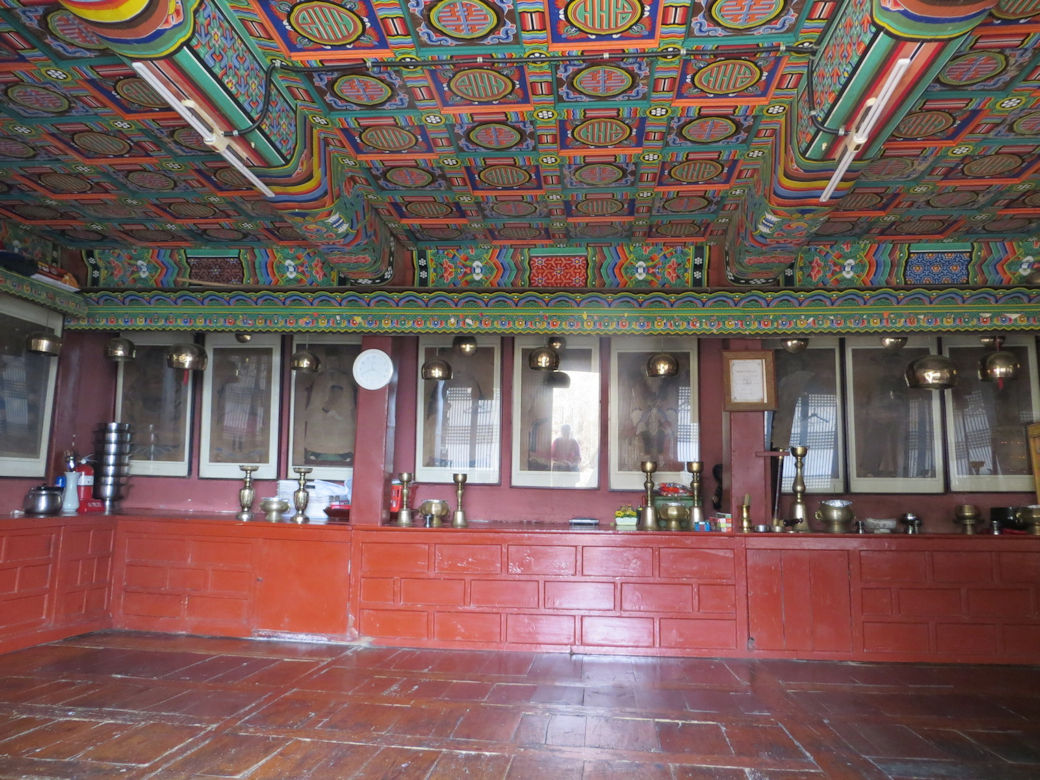
Outside Korean National MuseumLunch was not until nearly 3 pm and Sally had a meal with cutlet, salad and ball of rice. Then we went on to the City of Seoul History Museum (past the Hammering Man sculpture). As we got there Sally had an attack of diarrhea so the first half hour was spent in the very nice museum bathroom. Then we went through the museum, concentrating on the period past 1850s. It started with early city development when King Taejo chose it (Hanseung) as the location for the capital of united Korea. There was prominent mention of the impacts of Japan’s colonial rule that started in 1910 following a 1907 peace treaty. However, there were gaps in the story, who made the peace treaty and why? Dinner was close to Pop Jongno Hotel. We tried to order just a bowl of rice for Sally since her stomach was still unsettled. But the employees there refused to sell us that. This is when we realized how rigid the Korea society can be – everybody follows the rules no matter how unreasonable they are. So we ordered a Bibimbap type dish. David ate the meat and veggies and Sally the rice. (The next night we found a place that would sell us me a bowl of rice!) However, Sally’s digestive problems didn’t improve. Saturday was a big hiking day. Sally was eating very little - just a few crackers several times a day, but she drank a lot of water and survived. We hiked to the shamanist shrine and Buddhist temples on Mt Inwangsan on the north side of Seoul. We took the orange line to Dongnimmun to find the trail going up to the shrine. After walking up some steep paved streets, we reached the shrine. The shrine itself was a bunch of dead branches twisted together – sharmanism is a natural object worship practiced before more established religion. People had placed food and flowers as offering. Next to the dead branches is a shamanist “temple”. For us it is an eye opener in that there is no Buhda stature in the temple.
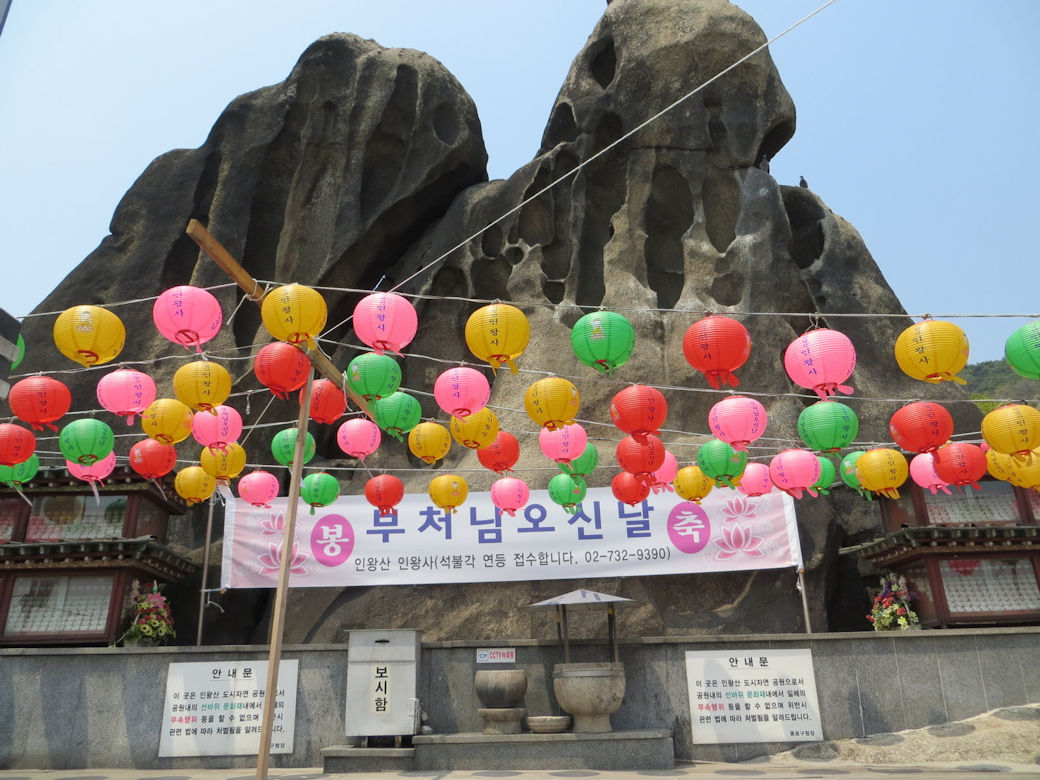
(L) Shamanist statues (R) Shamanist tree outside shamanist temple (L) Shamanist temple (R) Lantern for Buddhist Birthday celebration
Temple built next to two rocks resembled two sitting monks. Women came here to pray for fertility.We met several others going up the same trail – some stopped at the shrine to make an offering and pray. We could see a Buddha carved into the bare rock face near the trail. High above, the rocks were oddly shaped and you could see why locals claimed these rocks formed the shape of the head of a monk. Besides those going up to the shrine to pray, there were many like ourselves enjoying the hike and the views. One was a friendly and cheerful 75-year old local Korean who wanted to know where we had come from. He was from Seoul, a retired school teacher who has been to Honolulu and Los Angeles. He wanted to go again to the US to see NY and Washington DC but he is on a pension and has to save for a few more years before he can go. Another group were Canadian and American young college grads (liberal arts degrees, they joked) who were here in Seoul for a year teaching English to young Koreans (ages K through 4th or 5th grade) at private schools. We chatted for a bit; the young man told us it was possible to climb to the top and then down the ridge and up the next peak – Bukaksan. The young folks went on ahead and David and I followed, but not close enough to see exactly how they got to the top of the peak which was on the other side of the city wall. The trail started branching and it was hard to determine which was the main trail. Then came a difficult 45 minutes in which David and I scrambled up and down, steep, slippery sandy slopes on poorly marked trails complete with brambles and nasty barbed wire. My sandals were loose and not at all the right shoes on this surface. I had to slide down a couple slopes on my butt, hoping my new black nylon hiking pants would not rip. At one point I saw a very lovely purple-striped miniature iris but was too far from David and his camera to get a shot. We backtracked a few times until finally we got to a set of civilized concrete stairs that took us easily over the city wall. I was ready to quit, and David was disappointed but let me call this. Then I realized we had done the hard part, and we could see the top with people enjoying the view. So we went up, easily, and were surprised at the seriousness of South Korean military who patrolled this city wall at the top and would not let us take pictures. David got one of course, using me as the subject but shooting his 20x zoom to get a shot of the military installation at the top nearby. Below us on the north side of Inwangsan we could see barbed wire in two parallel fences forming yet another wall with about six feet in between the wire fences. It is hard to believe that barbed wires would be effective in wartime in this day and age (although they gave us lots of trouble earlier).
Military installations at top of Inwangsan. soldiers, cannons and sand bags are clearly visible
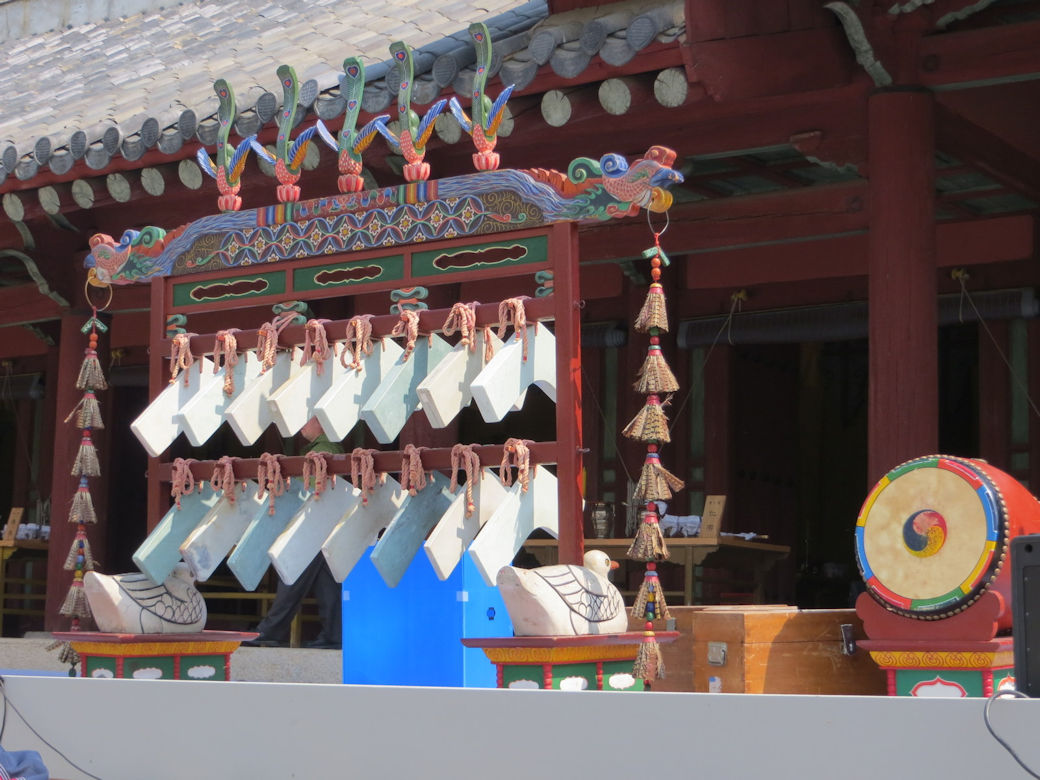
(L) Inwangsan from below. Note the wall with path leading up to top (R) More military installation on top of InwangsanIt was a pleasant walk back down, a different way that kept us on a paved path just on the outside of the city wall. As we got down into the city we searched for a pastry shop. Didn’t find any, so took Metro back to the Jongno-3 area where we found a coffee shop. David got a cookies and cream cheesecake slice and I got 2 little plain scones and ate one. We headed back to our hotel and showered. Dinner that night was a little independent shop on Jongno-ru where the woman running it had no problem giving me my own separate bowl of rice. The next day we went to going to Cheongdeokgung Palace and the annual honoring of ancestors at Jongmyo Shrine. Korea is now alone among the “Confuscian countries” that still performs these rites. The day was cool in the morning but quickly warmed up. We walked along Jongnyo-ru to the park, and found lots of people gathering and preparations going on at two locations Gyeongnyeongjeon (newer shrine honoring 16 kings and queens) and Jyeongjeon (original shrine honoring a number of kings and queens). For the first time we saw lots of Caucasians in the crowd (all this week we have seen only one or two here or there as we toured different parts of the city). We found a good spot at the northern Gyeongnyeonjeon shrine where they were letting people sit just outside a roped off area for the performances. A lady “drill sergeant” was placing the school boy performers’ sticks on the ground and adjusting them just so. Several different kinds of drums were located in the performance area, also some on stage, and in both areas were arrayed sets of bells, a gong, and suspended stone angle pieces that look sort of like boomerangs. With others in the crowd, we got hotter and hotter. Put on hats and sunscreen. A lovely man assisting with crowd management passed out paper sun visors and handed out seat cushions. We were lucky enough to get cushions and were right at the edge of the crowd at one corner of the performing area.
(L) Trying to keep cool in parade (R) Crowd watching the parade
Percussions for the parade
More percussionsFinally performers and officials entered – the schoolboy performers from the west; the officials and leaders of the ceremony from the south; musicians from the east, all in full length colorful dress-costumes. The schoolboys had red dresses slit on the sides so that a royal blue lining showed. The officials had black rounded top hats with a bolt piercing through it, the nut on one side and the sharp end on the other. A number of leaders went up to the set of 16 shrines arrayed on the north side, and bowed and prayed in front of each one. Finally a leader came to the microphone and began a sonorous chant. Drums accompanied him, and the dancers with their sticks bowed in various directions.
(L) Priests in parade (R) Performers
(L) Chief Priest chanting (R) Volunteer in palace groundWe got hotter and hotter. A woman came from behind us and pushed herself and her two grandchildren to the rope in front of a guy next to us, who had been praying seriously. Finally after 45 minutes of not much change in the ceremonies, we scraped ourselves to our feet, leaving our excellent seat locations complete with brown seat pads for some lucky and more devoted in the audience to grab. We then went to the English-language Cheongdeokgung Palace tour. The first tour of the palace buildings was led by a young man who straight away said it was his fifth time giving the tour. His English was decent but quite accented, and he stuck to a script. When I asked a question about the little animal figures on the palace roofs, he said he would get to that question later on the tour (but never did). It was a large complex of buildings separated by stone pathways and open dirt courtyards and border shrubbery, azaleas and trees. Some of the buildings looked a lot like Korean Buddhist temples, but they had the yin-yang 3-color Korean symbol at a prominent spot in front, under the roof line. He went through some detail explaining why the royal line had died out in the 20th century from the lack of direct male heirs (cousins don’t count).
Inside Cheongdeokgung palaceThe second tour of the Secret Garden was much more enjoyable. Our female guide challenged us, teased us, asked us questions, and told stories. She kept a fast pace on these several hundred wooded acres that seemed a natural woodland not a park in a city of several million people. Azaleas bloomed, there were mostly deciduous but some pine trees. The garden contained other buildings of the palace complex, including the separate housing for men and women – with a back corridor connecting them for night visits.
The Secret Garden in Cheongdeokgung PlaceOne pond surrounded by gardens and a pavilion to the side was used for reciting and composing poetry. If you couldn’t produce a poem, you were banished to the little island in the middle of the pond. Leaving the tour, we passed a 750 year old juniper, massive and heavily branching, with supports for much of the tree. Out on the street, we tried a treat from a food cart – little fried dumplings with apple filling – nice and sweet. Sign Guestbook Back to Home Page Seoraksan National Park Gyeongju Seoul Part 2 |