
|
GyeongjuAfter Seoraksan, the original plan was to take the express bus back to Seoul and then take the fast train from there to Gyeongju. This plan was made according to the information that we got over the internet - going along the coast by bus will take much longer since the bus winds around the coastal highway. While we were leaving, the hotel manager told us that there is a new highway that does not go through all the little towns along the east coast. The hotel manager got us a taxi to go to the Sokcho bus station even though we have only 20 minutes left before the bus leaves. The taxi driver raced from the National Park to Sokcho along a different route (through a tunnel that we did not know exist). It was like in the Amazing Race. We made it to the bus station with time to spare. The taxi stopped right in front of the bus, we hopped off the taxi and jumped into the bus. We did not have time to go into the station to get bus tickets. On top of that, we did not have enough cash (we planned to use our credit card to buy tickets in the bus station). I indicated that to the bus driver by showing him my credit card and saying credit card and no tickets. I think he understood me since he waved us into the bus and took off. My assumption was that he could take credit card payments on the bus, but it turned out that he could not. We gave him all the Korean cash that we have which was not enough. So at the next large bus station he and I got off to look for an ATM. But, not to my surprise, none of the ATM we found worked with foreign bank transactions (it is like that throughout Asia - at least in Japan, China and Korea). We winded up waiting in the long line at the station ticket counter. Of course he could not wait that long since his bus has a schedule to make. Then he had an aha moment – I saw his eyes lit up and he mumbled something. He led me back to the bus and continued our journey. He didn’t tell me anything (maybe he did in Korean but I couldn’t understand him). A Korean fellow traveler told us later on that the driver let us ride without the full payment. We did not get a receipts for the money that I paid him either. Koreans are very strict about receipts. The bus driver was going to give me a receipt for the bus tickets we were going to buy. (By the way, it was on an entirely honor system. I don’t see any way to track the payment other than his hand writing on a pre-printed receipt form.) My take on his aha moment is that he was going to follow all the rules but it was impossible. So he decided to go on the journey ignoring that we were ever on the bus – no tickets, no receipts. He might have taken our money without reporting it. If he did report it, he probably has to explain to the official/bureaucrats why he let us ride without paying the full price. Not following the rule is frowned upon in Korea. We were grateful that he did not kick us out though. We saw quite a few Christian churches on our bus ride to Gyeongju. This is surprising considering that Korea has more Confucius tradition than in China. But then on the other hand, there are lots of Christians among the Korean immigrants in this country.


The next day we went to the National Museum, which had good archeological history of Silla dynasty which lasted from 50 BC to about 1000 AD and included the unification of the three kingdoms on the Korean peninsula in the 7th century. We were competing with many tour-bus loads of Korean school children, some very young (3rd or 4th grade), and their teachers herded them single file past the museum exhibits. Interestingly, the students just filed past the exhibits. We didn’t see anybody explaining anything to them. It was like they were mindlessly going through the motion. They were pretty noisy and we could almost not hear our audio-book explanations as we passed individual exhibits. So we went out of the main building and started over, touring the Arts building. And at about 11:30 the schoolchildren all seemed to disappear for lunch.


We then were able to see the main building as well, and a third building. The third was a smaller building with exhibits around the walls, centered around a large wooden canoe-like boat, perhaps 25 feet in length, made of heavy wood. You could see crude joinery at two places along the length. Most of the exhibits including the boat had been discovered when the pond next to a palace had been drained for renovation – all these things had been preserved in the mud at the bottom of the pond.


It was a long hot walk back toward the city and Tumuli Park. We talked to some high school girls on the way. They were interested in practicing their English, such as “Hello!” Where are you from? Seattle? I love Seattle? Apparently “Sleepless in Seattle” was a big hit in Korea. They even have a Sleepless in Seattle coffee shop!

Lunch was most interesting. We finally found a restaurant after using the word “Saambap”. A nice taxi driver actually drove us (at no charge) a few hundred feet and pointed, because we couldn’t figure out where it was. The waitress brought us “Saambap.” Small wet towels to wash hands came first, followed by a huge array of dishes. No Coca-cola, but at first she brought us cups of water and later refilled those with milk-tea. The dishes were – 2 or three kinds of soup – including one like a miso soup with tofu, only a thicker, darker broth; and a sort of pea soup. There were a couple meat dishes, including one that seemed to be slightly chewy chicken fragments with a bit (not too much) red sauce; and another that was small pieces of beef with a tasty slightly sweet coating. Vegetables – very thin daikon slices in sweet-sour pickling; some white straw mushrooms; lettuce leaves; kimchee. There were at least two kinds of fish – one was a whole 8-inch roasted fish like a mackerel, very tasty and good – the bones could be pulled out easily. And one that was anchovies, typical and very salty. We ignored a couple dishes because there was so much, and we tried a couple even though they didn’t look appealing. There was a dish of yellow custard that I swear was tapioca but David thought just egg custard – but instead of being sweet it was neutral and slightly salty. There was seaweed. There was one vegetable dish with a daikon type root the size of a carrot, but swathed in red pepper sauce. It looks quite phallic. One soupy hummus. One dish I thought was green olives but was little brown cooked quail eggs. Dessert was a most surprising pancake sandwich – with sweet red bean in middle. One dish had three dark green pickled peppers – looked like Jalapeno but not really spicy, according to David, who was gutsy enough to try them.
We walked north through Tumuli park. It has a series of ancient burial mounds. With the exception of one mound, most of them have never been excavated for respect of ancestors. Korea is the country that adhered to the Confucius tradition. In the park, we met three 63-year-old gentlemen who had gone to elementary school together. They now lived in suburbs about an hour from Seoul and were gathering in Gyeongju for a reunion. One guy particularly friendly, wanted to know where David and I were from, gave us his email address, took photos all together.


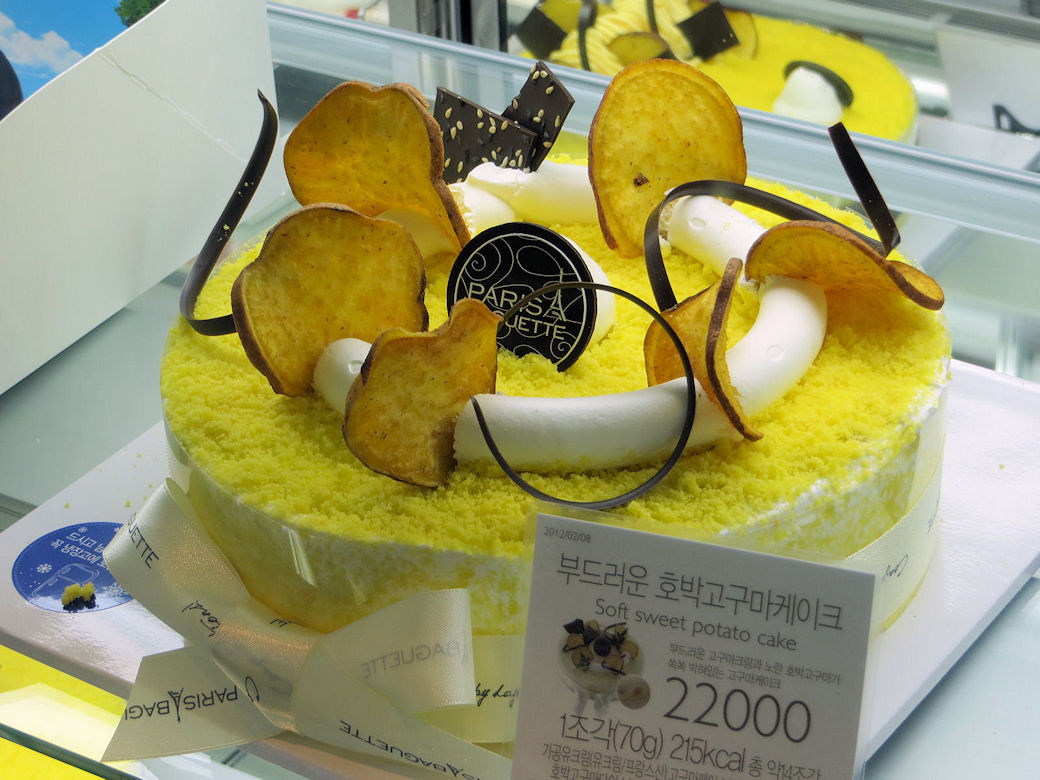
The lunch had been late and large, so we did not feel up for a real dinner out. After dark we walked down our side street a couple blocks and found a convenience store where we bought two bowls of ramen. The store clerk put them in a paper bag for us, we paid, and off we walked back toward Sono Hotel. Half way there I thought about how we would eat the ramen. “We need chopsticks!” Back we went to the convenience store. She said something, and pointed into the bag – there were two sets of chopsticks in their paper sleeves. We laughed and headed back to the hotel. We had breakfast cinnamon rolls (without any cinnamon) at Paris Baguette, and bought sandwiches there for lunch. The plan was to rent bicycles and ride out to Bulguksa Temple (16 km from Gyeongju City) to see the temple and a Buddha at Seokguram Grotto (another 3.2 km further). We hailed a taxi to get to the south side of Tumuli Park where the bike rental area was. But the bike rental lady, a young woman with little English, told us she could only rent by the hour on a Saturday/holiday. And she strongly discouraged us from biking all the way to Bulguksa, saying the roads were bumpy and traffic would be bad. We decided to take local bus to the temple. The 3.2 km walk from temple to grotto would be plenty of exercise. Besides, there were no bike helmets. Good decision, as it still took us plenty of time to get the local bus out there. The day was clear and getting hot – probably mid 70s but the sun was very intense. During the day, walking the whole time, we constantly sought shade. The local bus went through the Lake Bomun/Bomunho Resort, a newer development outside the city around a lake. Big hotels, an amusement park, a folklore craft village. Lots of young people were taking the bus there to spend the day. It took about 30 minutes to get to the temple, which is a complex of buildings on a hillside above a well-developed suburb. As is typical of Asian historic sites on UNESCO Heritage list, it was highly developed, which is really necessary because of the crowds. There was an outer area for parking, tourist information, bathrooms, ticket office (4000 won each adult, or $3.75.) We passed through the main gate into a series of temple buildings separated by courtyards of bare soil, some good sized trees for shade. The main temple to Buddha had a dark interior, but the golden Buddha statue was visible with Boddhisatvas on either side. Some visitors stepped into the room, over a lintel, to kneel on mats and pray, some bowing their heads to the stone floor. There were signs for no photography, but a few people snapped photos anyway. A clerk was in a side booth in a place where she could step out to enforce common courtesies, but she was engrossed in her writing or cell phone. The temple structure was very similar to temples we’ve seen in China. Pretty good condition but some of the ornate green/blue/dark red paintwork was faded. On the outside walls above doorways but below the roof, were pictures painted on the wood – lotus flowers, elephants, a female deity, a white crane. The ends of beams sticking out from under the roofline were carved into beaks of birds, or snouts of boars, or dragon shapes. On the more important buildings, the space under the ends of the convex roof tiles were not packed with concrete but had tile end pieces, with a relief in shape of lotus flower or vine or concentric pattern of dots.


At a side building we were amused to see that little cairns of small rocks, each about 10 inches high, had been constructed in the depressions between roof tiles on the surrounding walls. And the six foot wide border of courtyard around the building which was bare soil well shaded under trees, was entirely populated by these little cairns and three teenagers were building cairns of their own. I asked them what they were doing, and they laughed and said “praying” all three of us. So I built a little cairn and David took my picture. (As we found out in the Swiss Alps a couple years later in 2014, building cairns has become a tourist “tradition”, similar to putting padlocks on bridges.)


From Bulguk-sa we walked on a trail – a wide, formally-laid out stone path – 3.2 km – a steadily climbing path, up perhaps 1000 ft - to Seokgaram grotto. Many Korean tourists were also walking – a few young people’s groups, as identified by matching sports outfits – family groups, pairs and individuals. Like in Seoul, some of the Koreans were very trendily outfitted in trail gear from K2 – snazzily colored jackets, matching hats and running gear, complete with the latest body-shaped backpacks. Some wore gloves to keep the sun off their hands, and a few had face masks, we think because of the recent H9N7 bird flu outbreak in China. Almost no Caucasians. It took more than an hour to reach the grotto. It was hot and we were going uphill, but fortunately there was partial or complete shade along the path. There were benches at a few spots along the path, and well maintained bathrooms. At the top, but still below the grotto, there was a Korean bronze bell (4 ft high?) suspended from a wooden structure with temple-style roof and painted colors. People were paying 1000 won (to go to charity) to strike the bell. Further up, just below the grotto was a terrace decked out with paper lanterns of pink, green, blue and yellow forming a colorful, nearly solid shaded area, for the upcoming Buddha’s birthday celebration. Snack stand were off to one side, and families were taking a break with ice cream or other snacks and drinks. We walked past a booth offering English-speaking tour of the grotto, and ignored this offer and walked up. The Buddha statue is inside a formal stone chamber, with the stone walls in a semicircular shape behind the Buddha. This grotto was constructed in 752 AD by the prime minister xx of the Silla dynasty at that time, in honor of the Silla king xxx. The walls had many painted Buddha and associates figures. The Buddha itself was golden color with a small indentation on the forehead where a jewel had been fastened – gone after Japanese occupation. Its face was serene, its hands in the classic right hand pointed down to ground, left hand face up cradling the cares of the world. The stone image was simple and beautiful. It was behind a glass panel. We walked through and had plenty of time (in terms of crowding and numbers of people viewing) to gaze. There were two carved stone Boddhisatvas – one on each side. And 8 total associates behind, these were painted, if I remember correctly, not carved.


We actually went through twice, because it seemed anticlimactic to look for only five minutes after an hour-plus of walking. And finally, after a drumstick (ice cream) break, we talked to the English tour guide. He was very fluent and explained some of the history, including the Japanese attempting to take this Buddha away, presumably all the way to Japan, however, they only succeeded in moving the statue a few feet forward. Then, he said, the statue was unbalanced, and some stones and the glass panel had to be added to protect it. He kept talking about the temperature in the grotto being 13 to 14 degrees C, and something about humidity. The guide added some comments about Buddhist philosophy, noting there were two strains of Buddhism that came out of India/China, and then the third, Zen (Seon) Buddhism was developed in Japan/Korea. The former focused on studying and memorizing the sutra, the “threads” or words written down about what Buddha’s teachings were. The latter focuses on using meditation to achieve Nirvana. The guide did not ask us what our religion is, but asked “Where do you come from?” as in, what were you before you were conceived by your parents. I said, I believe I did not exist. David said the same thing. The guide talked about the destiny of us coming together at this time and place, and said we may meet again. And he may be destined to visit Seattle someday. Some of the philosophy did not come across clearly. He encouraged us to make a donation to help support the Buddha’s birthday festivities, but said we should not feel obligated to do so. No pressure, which was nice. He was very pleasant, cordial, and professional. Dinner: Hmmm not so good. After rest and shower at Sono Hotel, walked quite a ways to find a bank with Global ATM. Succeeded, finally. We walked to train station to look for a restaurant, David really wanting hot noodle soup. We found a Chinese hole in the wall restaurant run by Koreans. David had noodles with a red sauce; I had noodles with black bean sauce, tiny mushroom slices, and bits of minced beef. The sauces came separate from the noodles and there were a couple condiment dishes – the nice slice sweet pickle made from yellow squash, and plain, uncooked white onion slices. I did not really like my dish – it had plenty of black bean flavor, but not enough salt or spice. So I added soy sauce and a few red pepper flakes. David said his was good. The waiter came over and showed us how to mix the sauces with the plain noodles – “Spaghetti” he explained. Sign Guestbook Back to Home Page Seoul Part 1 Seoraksan National Park Seoul Part 2
|


